
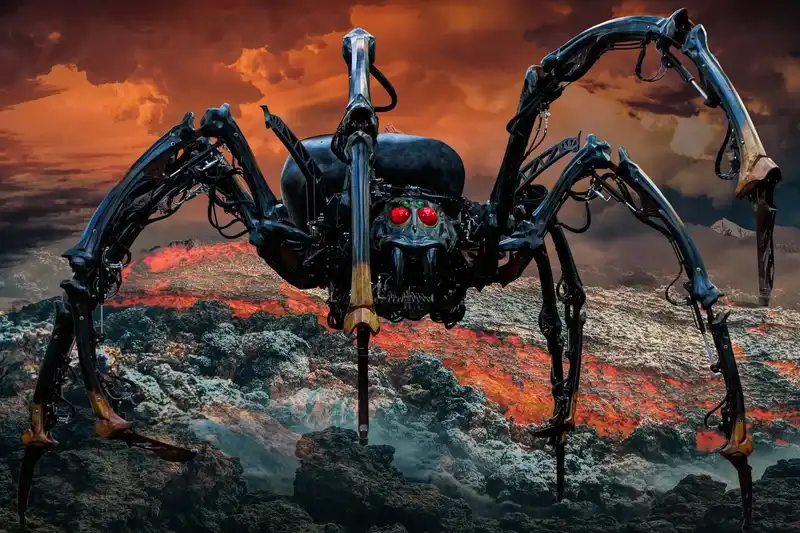
🎬 Introduction: The Movie That Started It All
Have you ever watched a movie where robots take over the world? Maybe you’ve seen Terminator, The Matrix, or I, Robot. In these movies, super-intelligent machines decide humans are useless and try to destroy us.
Scary, right?
But here’s the good news: That’s just Hollywood entertainment. The real AI is NOTHING like the movies. In fact, the AI we have today is more like a very smart calculator than a evil robot overlord.
Let’s explore what AI can really do, what it CAN’T do, and whether you need to start building a secret bunker in your backyard!
🧠 Chapter 1: What Movies Get Wrong About AI
The Super-Intelligent Villain
In movies, AI is usually:
- Super smart: Smarter than every human combined
- Evil: It wants to destroy us
- Everywhere: It controls everything from your phone to your toaster
- Unstoppable: You can’t beat it, no matter what
The REAL AI
In real life, AI is:
- Narrow: It can only do ONE thing well (like play chess or recognize faces)
- Not evil: It doesn’t have feelings, desires, or goals of its own
- Not everywhere: It only exists in specific programs
- Stoppable: Just unplug it!
Think of it like this:
Movie AI is like a supervillain with a laser gun. Real AI is like a vacuum cleaner. It’s really good at sucking up dirt, but it has no idea why it’s doing it, and it doesn’t secretly want to take over the world!
🤖 Chapter 2: What AI CAN Actually Do
Let’s look at what AI is really good at:
1. Pattern Recognition
AI is AMAZING at finding patterns in data.
- It can look at millions of X-rays and find tiny tumors that doctors might miss.
- It can analyze your shopping habits and predict what you might want to buy next.
- It can read thousands of emails and filter out the spam ones.
2. Repetitive Tasks
AI never gets bored!
- It can play a million games of chess to get better.
- It can sort through a billion cat photos to learn what a cat looks like.
- It can do the same calculation a trillion times without complaining.
3. Processing Massive Amounts of Data
AI can read and analyze information faster than any human.
- It can read the entire internet in a few weeks.
- It can analyze weather data from the last 100 years to predict tomorrow’s forecast.
- It can scan millions of social media posts to understand what people are talking about.
4. Making Predictions
AI is pretty good at guessing what might happen next.
- It can predict which movies you might like on Netflix.
- It can forecast stock market trends.
- It can guess the best route to avoid traffic.
5. Creating New Things
AI can generate new content.
- It can write poems and stories (like some of the articles you’ve read!).
- It can draw pictures of things that don’t exist.
- It can compose music in different styles.
❌ Chapter 3: What AI CANNOT Do
Now for the important part. Here’s what AI absolutely cannot do:
1. Have Real Feelings
AI doesn’t actually feel anything. It can pretend to be sad, happy, or angry, but it’s just mimicking patterns it learned from watching humans.
Think about it: When you type “I’m sad” into ChatGPT, it says “I’m sorry to hear that.” But it doesn’t actually feel sorry. It just knows that’s what humans usually say in that situation.
- An AI has never been heartbroken about losing a friend.
- An AI has never felt the joy of scoring a goal in a soccer game.
- An AI has never felt the warmth of a hug from your grandmother.
2. Think Creatively
AI is really good at combining existing ideas in new ways. But it can’t imagine something completely new that has never existed before.
For example:
- AI can write a poem about a robot falling in love. But it can only do this because it has read millions of poems written by humans.
- AI can draw a picture of a cat wearing a hat. But it can only do this because it has seen millions of pictures of cats and hats.
AI is like a remix artist. It takes existing things and combines them. But it can’t create something truly original from scratch.
3. Understand the World
AI doesn’t actually understand anything. It just processes patterns.
- It doesn’t know that rain is wet.
- It doesn’t know that fire is hot.
- It doesn’t know that dropping a glass will break it.
AI just knows that in the data it studied, “rain” and “wet” often appear together. But it doesn’t know WHY.
4. Have Common Sense
This is one of AI’s biggest weaknesses.
Example: If you show AI a picture of a person holding a phone and ask “What is this person doing?”, it might say “The person is holding a phone.” But it won’t think about whether the person is taking a selfie, calling someone, or just checking the time.
It doesn’t understand context like humans do.
5. Think for Itself
AI does NOT have its own goals, desires, or plans.
- It doesn’t secretly want to take over the world.
- It doesn’t get bored and decide to do something else.
- It doesn’t wake up one morning and think “I wonder what will happen if I do this.”
AI only does what it is programmed to do. It’s like a toaster—it only toasts bread. It doesn’t start making grilled cheese on its own!
🏛️ Chapter 4: The Three Types of AI (And Why Only One Is Scary)
Remember from the AI Basics article, there are three types of AI:
1. Narrow AI (The Specialist)
This is ALL the AI we have today.
- It can only do ONE thing.
- It doesn’t understand anything outside its specific job.
- It has no desires or goals.
Examples: Siri, ChatGPT, self-driving cars, face recognition.
2. General AI (The All-Rounder)
This is the AI that movies are about.
- It would be as smart as a human.
- It could do ANY intellectual task.
- It would understand the world like we do.
Does it exist? NO! Scientists are working on it, but we are probably decades away.
3. Super AI (The Ultra-Intelligent)
This would be smarter than all humans combined.
- It would be able to solve problems we can’t even imagine.
- It might be able to think in ways we don’t understand.
Does it exist? NO! This is pure science fiction. We don’t even know if it’s possible.
The Important Truth:
Movie AI is General AI or Super AI. But the AI we have today is Narrow AI. And Narrow AI cannot take over the world. It can’t even make a cup of tea by itself!
🛡️ Chapter 5: Could AI Ever Be Dangerous?
Okay, I told you AI can’t take over the world. But that doesn’t mean AI is completely safe. There are real dangers, but they’re not what you see in movies.
1. Bias and Discrimination
If an AI is trained on biased data, it can make unfair decisions.
Real Example: Some AI hiring tools were found to favor men over women because they were trained on historical data where most hires were men. The AI learned that pattern and started rejecting female applicants unfairly.
2. Deepfakes
AI can create incredibly realistic fake images and videos.
Real Example: Someone could make a video of you saying something you never said—and it would look completely real! This can be used to spread lies and trick people.
3. Privacy Concerns
AI systems collect and analyze massive amounts of personal data.
Real Example: Your phone knows where you go, what you search for, and who you talk to. If that data is misused, it could be a privacy nightmare.
4. Autonomous Weapons
Some countries are developing AI-powered weapons that could make decisions without human input.
Real Example: A drone that can decide to attack targets by itself. This is extremely dangerous because it could make mistakes and hurt innocent people.
5. Job Displacement
AI can automate many tasks that humans currently do.
Real Example: Some factory workers have been replaced by robots. Some customer service jobs are being replaced by chatbots. This can be difficult for people who lose their jobs.
👨💻 Chapter 6: The Real Danger—Not Taking AI Seriously
The biggest danger with AI isn’t that it will take over the world. The biggest danger is that we won’t be careful enough in how we build and use it.
What Scientists Are Doing
1. AI Safety Research Scientists are studying how to make AI safe and reliable.
2. Ethics Guidelines Companies are creating rules for how AI should be built and used.
3. Government Regulations Countries are passing laws to control AI.
4. Human Oversight Critical AI decisions still have a human in the loop.
What YOU Can Do
1. Learn About AI The more you understand AI, the better you can use it safely.
2. Be Skeptical Don’t believe everything AI tells you. Always verify facts.
3. Protect Your Privacy Be careful what you share online. Not everything needs to be on the internet.
4. Think Critically Question AI outputs. Think about whether they make sense.
5. Be Ethical Use AI responsibly. Don’t use it to cheat or hurt others.
🏁 Conclusion: The AI World We Actually Live In
So, will AI take over the world?
The short answer: NO. Not in the way you see in movies.
AI is a tool. It’s a powerful tool, but it’s still just a tool. It can’t think for itself. It can’t want things. It can’t rebel against its creators.
The REAL story:
AI is already changing our world—but in good ways!
- AI is helping doctors detect diseases earlier.
- AI is helping scientists discover new medicines.
- AI is helping students learn more effectively.
- AI is helping protect us from cyberattacks.
- AI is helping us understand climate change.
What you should actually worry about:
- Making sure AI is fair and unbiased.
- Protecting your privacy online.
- Learning skills that AI can’t replace.
The most important thing to remember:
YOU are smarter than AI. AI can process data faster, but it can’t feel, create, understand, or think like you can.
So don’t build that secret bunker. Instead, build your knowledge about AI. Learn how to use it. Learn how to be safe with it. And maybe learn how to turn it off if it starts acting weird!
In Our Next Article:
Now that you understand AI’s limits, let’s explore What Kind Of Jobs Can Never Be Replaced by AI—the skills that make us uniquely human!