
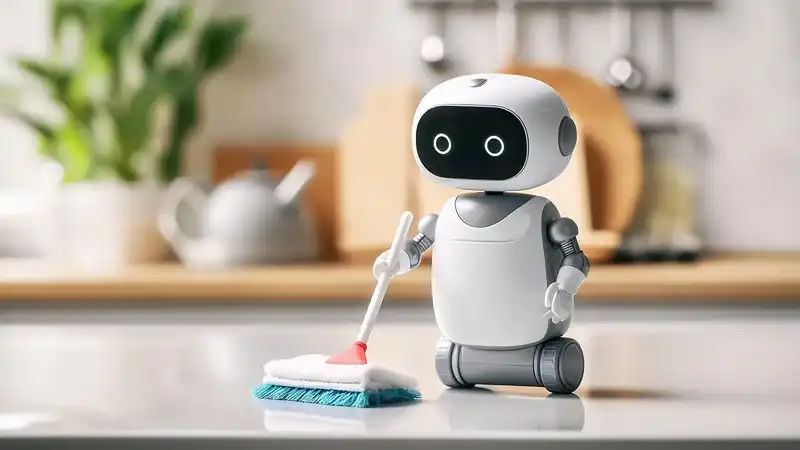
🧹 Introduction: The Dream of a Robot Helper
Imagine waking up to a clean room—without you having to lift a finger. Imagine a robot that:
- Cleans your room
- Does the dishes
- Helps you with your homework
- Bakes cookies
- Reminds you to do your chores
Sounds amazing, right?
The idea of robot maids has been around for decades. In movies like The Jetsons and Star Wars, robots do all the boring work so humans can have fun.
But is this actually going to happen? Will we have robot maids in our homes soon?
Let’s explore the fascinating world of home robots and find out!
🤖 Chapter 1: What Robot Maids Already Exist
You might be surprised to learn that we already have robot helpers in our homes!
1. Robot Vacuum Cleaners
The most common home robot!
- They automatically clean your floors.
- They navigate around furniture.
- They return to their charging station when they’re done.
Popular examples: Roomba, Roborock
What they do well:
- Clean floors without supervision.
- Run on a schedule.
What they can’t do:
- Empty the dustbin.
- Clean stairs.
- Pick up large items.
2. Robot Lawn Mowers
For outside chores!
- They automatically mow your lawn.
- They navigate around obstacles.
- They return to their charging station.
Popular examples: Husqvarna Automower, Worx Landroid
What they do well:
- Keep the lawn trimmed.
- Work independently.
What they can’t do:
- Edge the lawn.
- Handle complex gardens.
3. Smart Home Assistants
AI-powered helpers!
- They control smart home devices.
- They answer questions.
- They set reminders and alarms.
Popular examples: Alexa, Google Home, Siri
What they do well:
- Voice control for devices.
- Provide information.
What they can’t do:
- Physically do chores.
- Understand complex requests.
4. Robot Mops
For wet cleaning!
- They automatically mop floors.
- They navigate around furniture.
- They avoid carpets.
Popular examples: Braava Jet, iRobot Mop
What they do well:
- Clean floors automatically.
What they can’t do:
- Clean walls.
- Clean tight corners.
5. Robot Tutors
AI-powered learning!
- They help with homework.
- They teach concepts.
- They provide practice questions.
Popular examples: AI tutoring apps, educational robots
What they do well:
- Provide personalized learning.
- Explain concepts in different ways.
What they can’t do:
- Provide emotional support.
- Adapt to unique learning needs.
🚧 Chapter 2: The Challenges of Building a Robot Maid
If we already have some simple robots, why don’t we have a robot that can do EVERYTHING?
Challenge 1: Physical Dexterity
Humans are incredibly good at using their hands.
- You can pick up a fragile egg without breaking it.
- You can tie your shoelaces perfectly.
- You can fold a piece of paper neatly.
Robots struggle with:
- Delicate tasks (like picking up eggs).
- Fine motor skills (like folding clothes).
- Adapting to different objects (like different shaped cups).
The science: Human hands have thousands of tiny sensors that provide feedback to our brain. Robots have much fewer sensors, so they don’t know exactly how hard they’re gripping something.
Challenge 2: Understanding the Environment
Humans understand their environment naturally.
- You know that the glass on the table is fragile.
- You know that the rug on the floor is slippery.
- You know that the cat under the bed doesn’t want to be disturbed.
Robots struggle with:
- Understanding context.
- Adapting to new situations.
- Recognizing unexpected obstacles.
The science: Robots rely on sensors (cameras, lidar, etc.) to understand their environment. But these sensors can be confused by things like shadows, reflections, or unexpected objects.
Challenge 3: Cost
Building a robot that can do everything is extremely expensive.
- Sensors: $1,000+
- Motors: $1,000+
- Processors: $1,000+
- Software development: Millions of dollars
The problem: A robot maid that can do everything would cost as much as a luxury car—more than most families can afford!
Challenge 4: Safety
A robot that can move around your home could be dangerous.
- It might knock over valuable items.
- It might bump into a child or pet.
- It might get stuck and damage itself.
The challenge: Making a robot safe enough for everyday home use is extremely difficult. One mistake and it could seriously hurt someone.
Challenge 5: Battery Life
Robots need power!
- A robot maid would need to run for hours.
- It would need to recharge itself.
- It would need to manage its energy efficiently.
The problem: Most robots can only run for 1-2 hours before needing to recharge. That’s not enough for a full day of chores!
Challenge 6: Complexity
Homes are incredibly complex environments.
- Different rooms have different shapes.
- Furniture gets moved around.
- Children leave toys everywhere.
- Pets cause unexpected problems.
The challenge: Programming a robot to handle all the variables of a real home is extremely difficult. It’s much easier to make a robot that works in a controlled factory environment.
🔮 Chapter 3: When Might We Have Robot Maids?
Let’s look at what’s realistic and what’s not.
What’s Realistic in the Next 5-10 Years
1. Better Vacuum Cleaners They’ll navigate better, self-empty, and clean longer.
2. Robot Window Cleaners They’ll safely clean windows on high-rise buildings.
3. Robot Grocery Delivery They’ll bring groceries from the store to your doorstep.
4. AI-Powered Tutoring Learning assistants will get much smarter and more personalized.
5. Robot Security Guards They’ll monitor your home and alert you to problems.
What’s Realistic in the Next 20-30 Years
1. Robot Cooks They’ll be able to prepare simple meals from recipes.
2. Robot Companions They’ll provide company and conversation for elderly people.
3. Robot Cleaners They’ll be able to clean bathrooms, kitchens, and more.
4. Robot Helpers They’ll assist with simple tasks like folding laundry.
What’s Science Fiction (Maybe Never)
1. Full Robot Maids A robot that can do EVERYTHING—cook, clean, babysit, tutor—is likely decades away, if it ever happens at all.
2. Emotional Companions A robot that can truly understand and share your feelings is probably impossible.
3. Autonomous Decision Makers A robot that can make complex decisions without human input is very far away.
💡 Chapter 4: What Robot Maids COULD Do for You
Let’s imagine a robot maid that might be available in the next 10-20 years. What could it actually do?
1. Household Chores
It could:
- Vacuum and mop floors
- Clean bathrooms
- Wash dishes and put them away
- Fold laundry
- Take out the trash
It might struggle with:
- Making beds perfectly
- Organizing closets
- Cleaning delicate items
2. Tutoring and Homework Help
It could:
- Help with math problems
- Explain difficult concepts
- Provide practice questions
- Check homework for errors
It might struggle with:
- Understanding complex questions
- Providing emotional support
- Adapting to different learning styles
3. Childcare
It could:
- Monitor children while they play
- Read bedtime stories
- Help with basic tasks
- Alert parents if there’s a problem
It might struggle with:
- Providing comfort when a child is upset
- Understanding complex emotional needs
- Making good decisions in unexpected situations
4. Home Management
It could:
- Manage household schedules
- Track groceries and supplies
- Control smart home devices
- Monitor home security
⚠️ Chapter 5: The Risks and Concerns
Robot maids sound amazing, but they also raise important concerns.
1. Privacy
A robot maid would be constantly monitoring your home.
- It would see where you go and what you do.
- It would hear your conversations.
- It would collect data about your habits.
The concern: Who owns this data? Could it be hacked? Could it be used against you?
2. Safety
A robot moving around your home could be dangerous.
- It might knock over a child.
- It might spill hot water.
- It might cause a fire.
The concern: What happens if the robot malfunctions? Is it safe enough to be around children and pets?
3. Job Loss
If robots do all the work, what happens to people?
- House cleaners would lose their jobs.
- Baby sitters would lose their jobs.
- Tutors would lose their jobs.
The concern: What happens to the people who need those jobs to support their families?
4. Dependence
If we rely on robots to do everything, we might lose our own skills.
- We might forget how to clean.
- We might forget how to cook.
- We might forget how to do basic math.
The concern: Are we making ourselves weaker by relying on robots?
5. Social Isolation
If robots do everything for us, we might interact with each other less.
- We might spend more time with robots.
- We might lose social skills.
- We might feel more lonely.
The concern: Are we replacing human connection with robotic assistance?
🏁 Conclusion: The Robot Maid Reality
So, will we have robot maids in the near future?
The short answer: Yes, but probably not the ones you imagine.
We will likely have increasingly capable home robots—vacuum cleaners, mops, tutors, and security systems. But a robot that can do EVERYTHING a human maid can do is probably decades away, if it ever happens at all.
The reasons:
- Physical dexterity is incredibly hard to replicate.
- Home environments are too complex for current AI.
- Safety is a huge concern.
- Cost is prohibitive.
What’s more likely:
- Specialized robots for specific tasks.
- AI-powered assistants that help with homework.
- Smart home systems that automate daily tasks.
- Humans and robots working together.
The most important thing to remember:
Robots are tools to help us, not replace us. They can do the boring, repetitive tasks so we can focus on things that matter more—like spending time with our families, pursuing our passions, and making the world a better place.
In Our Next Article:
Now, let’s talk about protecting ourselves from the dark side of technology—Will A.I Take Over The World!